
Protecting & supporting health and care workers
From deaths, illness, burnout and mental health issues experienced during COVID-19 to attacks and harassment in conflict zones, health and care workers around the world face occupational hazards and risks. The World Health Organization projects a global deficit of 11 million health workers by 2030, with two regions bearing an increasing proportion of the gaps. Urgent action is needed to protect, support and safeguard health and care workers as a vital component of strong and resilient health systems.
The Global health and care worker compact identifies ten areas of focus within four domains – preventing harm, providing support, ensuring inclusivity and safeguarding rights –where governments and societies can improve the work environments and rights realization of the people doing health and care work. The Health and care worker law and policy lab consolidates national laws across each of those domains along with a guide to the existing international legal obligations to safeguard the rights of health and care workers and ensure that they have decent and enabling work environments. It is housed at https://www.hcwpolicylab.org/.
The Care compact assessment tool presents a structured approach for countries in evaluating the extent to which their laws, policies and governance mechanisms align with the Global health and care worker compact and related international labour and human rights standards. The tool is operationalized through a set of indicators and guided questions that enable systematic, cross-sectoral review of national policy and legal environments. Designed primarily for governments and relevant stakeholders, it facilitates dialogue, identifies policy gaps and supports the development of evidence-based action plans. Its modular structure allows both rapid overviews and in-depth analyses, while also enabling periodic assessments, data aggregation and comparison to monitor progress and inform health workforce policy and planning.
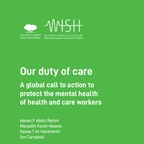
With the World Innovation Summit for Health and Qatar University, we are taking forward the recommendations of the Our duty of care mental health report recommendations by developing a practical tool at hospital level and a WHO implementation guide. In 2025, we conducted a workshop with colleagues in Qatar and Spain to operationalise and detail the intervention components and plan of action for service delivery.
Well-designed and implemented laws and policies support health and care workers, improve retention, and support their engagement in health systems, efforts to end future pandemics, and improve global public health. Law is among the most powerful public health tools to support those doing lifesaving work in clinics and hospitals, homes and care facilities, war zones and climate disasters. The first step in applying this tool is understanding how national laws may or may not support that goal.
Publications
Health and care workers need safe, healthy, supportive and dignified conditions of work. The Global health and care worker compact provides recommendations...
Working for Health 2022-2030 Action Plan
The Working for Health 2022-2030 Action Plan presents how WHO, Member States, and stakeholders can jointly support countries to optimize, build and strengthen...
This thematic brief accompanies the Working for Health 2022–2030 Action Plan, serving as a rationale to the related actions of the Working for Health...
Caring for those who care: Guide for the development and implementation of occupational health and safety...
Occupational health and safety programmes aim to prevent diseases and injuries arising out of, linked with or occurring in the course of work, while improving...
Caring for those who care: national programmes for occupational health for health workers: policy brief
Health is a universal human right and a main contributor to well-being, economic development, growth, wealth and prosperity for all. Health systems play...
Guidelines on mental health at work
An estimated 15% of working-age adults have a mental disorder at any point in time. Depression and anxiety are estimated to cost the global economy...
Bundibugyo Virus Disease resources
Infection prevention and control guideline for Ebola and Marburg diseases
Assessment and management of health and care workers with possible occupational exposures to Orthoebolavirus or Orthomarburgvirus: implementation guidance
Caring for those who care: Guide for the development and implementation of occupational health and safety programmes for health workers
Health workforce policy and management in the context of the COVID-19 pandemic response
Prevention, identification and management of health worker infection in the context of COVID-19
HealthWISE Trainers’ Guide: Work Improvement in Health Services
HealthWISE Action Manual: Work Improvement in Health Services
Events
News

People
Technical Officer, Policy, Norms and Standards, Health Workforce
Email: ckane@who.int
Technical Officer in Health Labour Market and Partnerships Unit
Email: mfendtnewlin@who.int
Coordinator – Policies and Standards